Tuesday, September 15, 2015

SSDI Allowance Rates Fall Under Obama / Colvin

Over the past year, enemies of the Social Security Disability Programs have waged a campaign of misinformation alleging that the Democratic administration of President Barack Obama has allowed the number of SSDI recipients to soar during his tenure.  An article recently published by The Atlantic shows that official numbers do not back up this accusation.  See Saving SSDI   

The article from The Atlantic notes that: "SSDI has become a more stringent program during the Obama years, admitting fewer than expected new recipients onto program rolls."  Here is a chart showing the actual figures gathered by the Center on Budget and Policy Priorities:
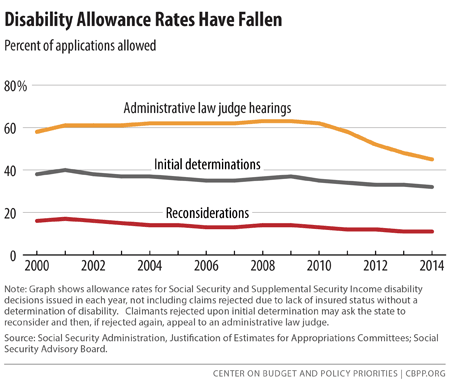
Another must read article on this issue was published by the Center on Budget and Policy Priorities: Disability Allowance Rates Fall as Social Security Strengthens Oversight of Hearings.  The articles states: 
The rate at which Social Security administrative law judges (ALJs) approve claims for disability benefits dropped for the fifth straight year in 2014, new Social Security Administration (SSA) data show. The ALJ allowance rate has fallen from 63 percent in 2008 and 2009 to 45 percent in 2014. Thus, claims that ALJs are “out of control” are without merit.

It should be pointed out also that the only time during the Obama administration when allowance rates increased was when the SSA was under the direction of Commissioner Michael Astrue.  Astrue was appointed by President George W. Bush, not Barack Obama.  Terms for SSA Commissioners are staggered.  When Astrue finished his term, President Obama appointed the the current Commissioner, Carolyn Colvin.  Official data clearly shows that allowance rates for SSDI have dropped, at all stages of the process, under Commissioner Colvin.

This is important information to keep in mind during the upcoming debate regarding the fiscal challenges that the Social Security trust fund will face in the fall of 2016.  As I have stated in previous posts, the problems facing the fund can be corrected with a relatively minor relocation of funds.  However, enemies of the disability programs are trying to manufacture a crisis in which they allege that disability allowance rates have gone wild over the past years.  As you can see from the latest numbers gathered regarding allowance rates, this accusation is completely false.  

Monday, September 7, 2015

Updating Your Social Security Disability Case

As we all know, the Social Security Disability claims process is very slow.  While you wait for your case to be decided, it is extremely important to continue receiving intensive medical care for your conditions.  Moreover, you must keep your lawyer updated on certain specific developments in your case.  Here is a list of certain things that you must keep your lawyer updated while your case is pending:

  • Any attempts to go back to work:  If you decide to work or to make an attempt to work while your case is pending, you must immediately notify your lawyer.  Be prepared to provide your lawyer with paystubs of all the payments that you have received.  Moreover,  you should provide your attorney with a list of the duties that you perform on your job.  Consult with your attorney to make sure your attempt to work is not inconsistent with your allegations of disability.  
  • Changes in address and other contact information:  This one is common sense.  Unfortunately, many clients forget to let their lawyers know about changes in address, email or telephone. Always provide your lawyer with alternative contact information from relatives or close friends in case that your are too sick to be able to respond to your lawyer when he or she is looking for you.
  • For SSI cases, any changes in income:  If you have an SSI case, you must notify your lawyer of any new sources of income received by you.  For example, if your former spouse begins paying alimony after the filing of your disability claim, you must tell your lawyer.  Changes in income can affect your eligibility for SSI.
  • Any offers to settle your worker's comp case:   If your SSDI case is pending, you should not sign a settlement agreement in a worker's compensation case without first running it by your Social Security Disability Lawyer.  Once you sign an agreement in a worker's comp. case, you might be stuck with a fairly high reduction in your Social Security Disability Benefits.  It might be possible for your Social Security lawyer to include language in the settlement agreement that prevents a high reduction (offset) in benefits.
  • New medical treatment and new doctors:  If you are receiving a new type of medical treatment or have a new doctor, you must let your lawyer know.  Be prepared to send the law firm an email, if possible, with the name of the doctor(s) or treatment sources, dates of treatment and the doctors addresses.

Monday, August 31, 2015

What is the Office of Quality Performance (OQP)? Is it Doing its Job?

The Office of Quality Performance is a division of the Social Security Administration that is in charge of randomly selecting cases for review.  The purpose of their intervention on a case is to ensure that decisions made at the local level are consistent with the regulations.  Bear in mind that at the initial application stage, cases are reviewed by DDS examiners who are not employed by the Social Security Administration.
Obviously, one of the purposes of this office is to prevent any particular state or region from issuing decisions that are too generous to claimants.  According to the SSA, one in every 100 cases are pulled from DDS for review.  If your case is selected for review, your case is likely to take longer to be decided.  
In my involvement in cases that have been reviewed by OQP, I usually find that the quality review process rarely works in an effective way.  All that QR does is to create an unnecessary layer of adjudication.  OQP employees aren't any smarter DDS workers.  OQP conducts yet another de-humanized paper review of a disabled person's claim, prolonging the time that it takes the agency to decide a case.  
In light of all the accusations of corruption in Kentucky, West Virginia, New York and Puerto Rico, I wonder where OQP has been.  The SSA and the critics of the disability program act as if these cases of corruption happened without their knowledge.  Really?  Any person reviewing 1 out of 100 cases at DDS in Kentucky or Puerto Rico could have easily spotted a pattern of deception by certain representatives.
OQP has an important mission.  More should be done to improve the quality of its work.  Its role shouldn't be to slow down the process and create a further layer of review.  Instead, the Office should concentrate in ensuring that the disability programs are fairly administered to protect the system from corruption and to safeguard the rights of the disabled.       


Monday, August 24, 2015

Deciding Whether to Appeal a Judge's Decision or File a New Claim?

Unfavorable decisions by Administrative Law Judges (ALJ's) are  on the rise.  As I have indicated in previews posts, last year, SSDI denials went up 15% at the National level.  I suspect that this percentage has continued to increase throughout the first half of 2015.  For this reason, a question that many claimants are currently facing is whether to appeal an unfavorable decision by an ALJ or instead, file a new application at the initial level.  Here are some of the issues that claimants must consider in making this difficult decision.
  • The Date of Last Insured Matters:  In deciding whether you want to appeal or file a new application, you must first find out your "date of last insured".  If your date of last insured is in the past, it will be very hard for you to file a successful new application.  In order to succeed, you must show that your disability began before your date of last insured.  On the other hand, if your DLI is in the future, you still have a chance to submit new information with proof of your ongoing disability,  For these reasons, I usually disfavor filing a new application in cases in which the DLI is in the past.
  • Do you Want to go Before the Same Judge, Again?:  One of the main problems of appealing a judges decision, is that if your appeal is successful it is very likely that your case will be remanded back for a new hearing with the the same judge who denied you.  Only in very rare occasions, will the Appeals Council take the case away from the judge who denied you or issue a favorable decision without the need of a new hearing.  This is one of the biggest drawbacks of appealing your case.
  • Are you Willing to Compromise Some of Your Past Due Benefits?:  One of the drawbacks of filing a new application is that you are potentially giving up your claim for past due benefits from your prior application,  Under some circumstances, giving up past due benefits might be a good trade off.  If time is of the essence and you think that your new application has a good chance of being granted early in the process, you might want to consider giving up your past due benefits.
  • Time Considerations: Almost everyone that I talk to is concerned about the length of time of that an appeal will take versus an initial application.  Both processes can be extremely lengthy. In most cases, it takes the Appeals Council more than one year to decide a case.  Assuming that the Appeals Council issues a remand, it takes the ALJ about another 6 months to schedule a hearing and issue a decision.  In terms of time, there really isn't a big difference between an appeal vs, and new application, unless your medical condition her worsened dramatically since the date of your hearing,  If your condition has worsened dramatically, then you might have a good chance of having your initial application granted relatively early.   
Determining whether to file an initial application or appeal is something that must be decided on a case by case basis.  I hope that this brief summary of the issues to be considered are of help in making your individual decision.

Monday, July 27, 2015

Obama, Guns and Social Security Disaibility

A gun control proposal by President Barack Obama could affect millions of Social Security Disability beneficiaries who have been deemed incompetent to handle their own affairs.  As is the case with most gun issues, the idea has sparked a heated debate.

Unfortunately, there is a great deal of misinformation on this topic.  This ignorance stems largely from the fact a large number of news reporters and public figures don't know much about how SSDI operates.  Since the SSA has the responsibility to insure that monies are properly used, it determines whether beneficiaries are capable of handling their own funds.  If they are deemed to be incompetent of handling their money, they are required to have a representative payee to handle their SSDI or SSI checks.  President Obama's proposal intends to report SSDI beneficiaries who have a payee to the National Instant Criminal Background Check System and prevent them from owning guns. 

About 4.2 million adults receive SSDI checks that are managed by representative payees. Opponents of the President's plan argue that that being incapable of managing funds does not necessarily make a person violent or dangerous.  At first glimpse, this argument seems to make sense.  However, if you have practiced Social Security Disability Law as long as I have, you know how hard the disability determination process has become.  Claimants are routinely denied benefits at all stages of the process based on their capacity to perform simple manual tasks such as: cooking, washing dishes, washing and folding clothes and taking care of pets.  I submit that a person who alleges to be able to handle a firearm is very likely to loose his or her Social Security Disability case.  Lets face it, operating a firearm safety requires a great deal of attention and concentration --far more than its required in simple sedentary jobs.  Moreover, firing a gun requires excellent manual dexterity, coordination and eyesight: all excellent skills that can be used in a wide array of occupations.

Nonetheless, I do recall winning at least one Social Security Disability for a client who was an avid hunter.  Needless to say, it wasn't an easy one.  I would be very concerned of representing anyone in the future who insists of maintaining any hobbies associated with guns (with the obvious exception of a very low key gun collector).  

Consequently, I am not thrilled by those who are defending SSDI beneficiaries' right to bear arms. SSDI is a financial lifeline for millions of disabled Americans.  Insisting on the beneficiaries' right to bear arms, could lead to an eventual denial or cessation of their benefits. For this reason, I believe that, at this crucial point in time, protecting the economic well being of the disabled is far more important than their right to bear arms.


Monday, July 13, 2015

New Listing for Children's Growth Disorders

The Social Security Administration has revised its listing for children with growth disorders and weight loss.  (Listing 100.00 and other sections)  This rule was published at 80 Fed. Reg. 19522 (Apr. 13, 2015) and went into effect on June 12, 2015.  Babies born at at 32 weeks of gestation and weight less than 1250 grams meet the listing.  Babies who weight less than 1200 grams at birth meet a different part of the listing regardless of how many weeks of gestation they had.
There are some new listings regarding children's growth disorders.  For example, section 100.5 pertains to children under 3 who "fail to thrive".  There are also new listings for growth failure caused by chronic respiratory disorders (listing 103.06)  and for renal disease (listing 106.08).  However, some listings were eliminated: (listings 100.02 and 100.03) for growth impairments related to a medically determinable impairment.
The new listing's objective is not to rely anymore on "linear growth" (height) alone, but also on a child's weight to length ratio or body mass index.

Monday, July 6, 2015

Avril Lavigne's Struggle with Lyme Disease

If you have suffered from a severe form of Lyme Disease or know someone who has gone through the ordeal associated from suffering from this condition, you know how hard it is to obtain adequate medical treatment.  Last week, Canadian pop star Avril Lavigne described on television her struggle with Lyme Disease, particularly how difficult it is to get a doctor to even acknowledge that a patient is suffering from this disease.

When I first heard her interview, her ordeal seemed incredibly similar to the experience of many of my disability clients.

Here is a video of her interview:
I hope that her account of her fight with Lyme Disease helps raise awareness regarding the difficulties faced by Lymes patients. In addition to suffering from lack of adequate treatment, these patients are often taken advantage by disability insurance companies and by the Social Security Administration because their doctors are not willing to make an adequate diagnosis,  If someone like Avril was labeled  "crazy" due to her unusual symptoms, imagine what an average disability claimant goes through.  Hopefully her appearance on ABC helps educate disability claims adjudicators that this disease is real and that, at times, it can be extremely disabling.